
Harold Hall


In theory, the capacitor will never be charged fully to the value of the voltage supplying it as the charging current will become progressively less as the two values attempt to merge. What then will control the charging time. The greater the value of the resistor the lower will be the charging current and therefore the longer will it take to charge up, Sk 14. The value of the capacitor will have a similar effect, the greater the value the longer will be the charge up time, in both cases though the charge voltage eventually reaches Vin.
Metalworking
Workshop Data
Defining the charge time, known as the "time constant" (TC), of a resistor / capacitor combination is with the mathematical product of their two values.
TC = R x C seconds
The resulting value is the time in seconds to reach a charge of 62.3% of the applied
voltage. At five times this value the capacitor will be essentially fully charged,
that is over 99%. In making the calculation, resistance must be in ohms and the capacitance
in farads. Do though note that the capacitance is in farads whilst in practice capacitors
are rarely more than a few micro farads, a factor of ten to the minus 6 must therefor
be included. Typically, a circuit with a resistor value of 2000000 ohms and a capacitor
of 25 micro farads the time constant will be 50 seconds. That is-
2000000 x 25 x 0.000001 = 50sec
The calculation is equally applicable to the discharge time with the product of the resistance and capacitance values giving the time taken for the charge to reduce by 62.3%, when the supply is removed and a discharge path provided.
If a discharge path is not provided when the supply is removed the capacitor will maintain its charge, only very slowly decaying as a result of the capacitors own leakage resistance between its two sets of plates. Televisions, especially older designs, were renowned for having lethal voltages present for this reason well after they had been switched off.
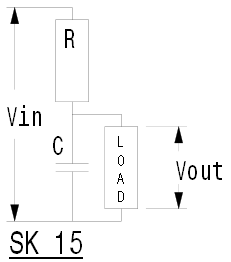
Uses for the resistor capacitor configuration are many but most if not all are there to make use of the time element. Many applications surface in electronic situations, frequently to limit the effect of interference, Sk 15.
A much simpler application would be for a simple timer. In this case, a fixed voltage (Vin) could be applied and Vout triggering some device when the voltage reaches a certain level. The time delay could be anything from a fraction of a second to a few minutes depending on the values of R and C. Using a variable resistor for R would enable the time to be varied.
In this example the time constant of R and C must be short enough for V out to follow accurately the varying input signal but sufficiently long not to react to the much faster interference spike, Sk 16.