
Harold Hall


Like the formula for Ohms law, the formula for power consumed can be expressed in a number of ways.
V²
Power = V x I or = R x I² or ———
R
At first, it may be considered that there is an error as the second formula shows the power is proportional to the value of the resistor R whilst in the third it is inversely proportional. Please be assured that it is correct it is a quirk of how the formulas are presented, one in relation to a known current and the other, a known voltage. As an exercise you could attempt to arrive at the second and third formula using the first formula for power and ohm's law.
Importance of the Power consumed
If you are constructing electronic circuits in the home workshop, available components, or simplifying their purchase, may dictate using resistors of a higher power rating than is needed. This though will not effect the working of the circuit in any way.
However, where space, weight, etc. is important, typically in aviation, or size of the component when fitted in portable domestic equipment, mobile phone for example, then working out the power dissipated so as to fit the smallest size resistor is an essential aspect of designing such item.
Capacitance
Whilst the term resistance in basic electrical theory is applicable to many components, not just a resistor, capacitance is only appropriate to the humble capacitor.
Of course, capacitance is a factor in other situations. A very long cable will have significant capacitance between its cores and at very high frequencies be a consideration at quite short lengths. Such considerations are though beyond what can be considered basic.
Probably the most simple explanation regarding the capacitor is to compare it with a rechargeable battery, it can store power provided from one source and then make it available later to another.
Metalworking
Workshop Data
However, here the similarity ceases as the battery will have a nominally fixed voltage between it being charged and discharged whilst the capacitor can be charged to any voltage value from zero up to its designed maximum.
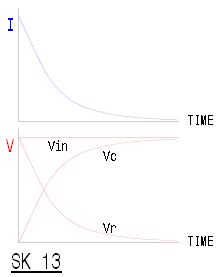
Initially, a fully discharged capacitor is the equivalent of a short circuit (zero resistance) and will theoretically take a very high current from the power source charging it, infinite if one applies a voltage to zero resistance. The current will though be limited by the power supplies own internal resistance and of the connecting cables, it is though rarely an acceptable situation. Because of this, capacitors are invariably fed via a limiting resistor which limits the initial current but has little effect on the value of the eventual charge voltage, only the time it takes to arrive at this.
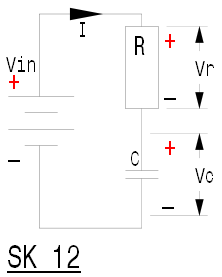
Let us consider the the circuit in Sk 12. Initially, with the capacitor fully discharged
(zero resistance) the circuit will be the equivalent of Sk 3 with the resistor solely
determining the level of the current. The flow of current will though commence to
charge up the capacitor and the resultant voltage begin to oppose the supply voltage.
Taking the example of the capacitor having reached a voltage of a half of the supply
voltage (Vin) the effective voltage in the loop will now only be a 1/2 of that originally
(Vin -