
Harold Hall


Holding Round Items
When requiring to hold round items the vice will first come to mind, if this is just to machine a small flat to take the end of a grub screw for holding a pulley then this is probably the way forward if the vice is already on the table. If though a keyway is required needing to be axially in line, the vice will need to be accurately positioned, a task time consuming.
The set-
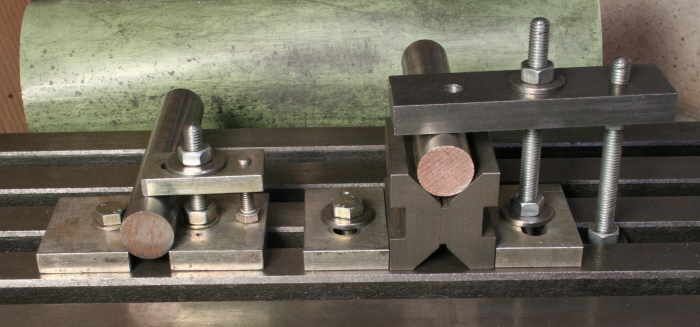
If you are considering using a V block as an alternative be warned. The force from the overhead clamp will be attempting to force the V apart and it is known for this to split the block into two parts. Even if you are confident of the strength of your vee block getting this accurately positioned can be a problem. Setting it between two plates in a similar manner to that proposed above would though suffice, Photograph 15 (right).
If attempting to use a V block for a small diameter item, then this may fall below the top of the block and clamping the part could be a problem. With the method proposed a wide range of sizes can easily be accommodated from as little as 3 mm up with theoretically no upper limit.
Using a part from the assembly being made
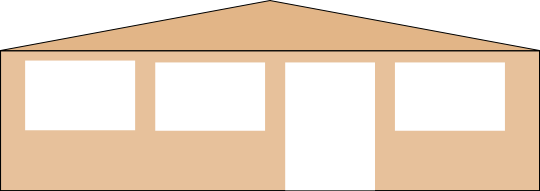
Do not overlook the possibility that some other part in the assembly being made could be used to hold the one being worked on for machining, being particularly useful where angles or complex shapes are involved. Having to machine the edges of a gib strip for use in a dovetail slide, setting up the tilting vice looked inevitable but the length of the gib strip was much longer than the width of the available vice. Having some reluctance to the method I hit on the idea of using the outer dovetails to act as a jig for holding it whilst having its edges machined, I no longer have a Photograph available of this set up but Sk. 2 should indicate the process adequately. This avoided the need of accurately setting up the tilting vice, and yet guaranteed that the angle was precise.

15