
Harold Hall


Toggle clamps
Another form of work table clamp that can prove very useful is the horizontal toggle clamp being especially useful for batch production due the speed in which the clamping force can be applied and removed. However, on the minus side they cannot cope with variations in the distance between the faces being clamped, it is therefore only appropriate for parts that are dimensionally consistent. Even so they can be beneficial in cases of just a single, or a few, parts where it would not be too daunting to adjust the clamp for each part.
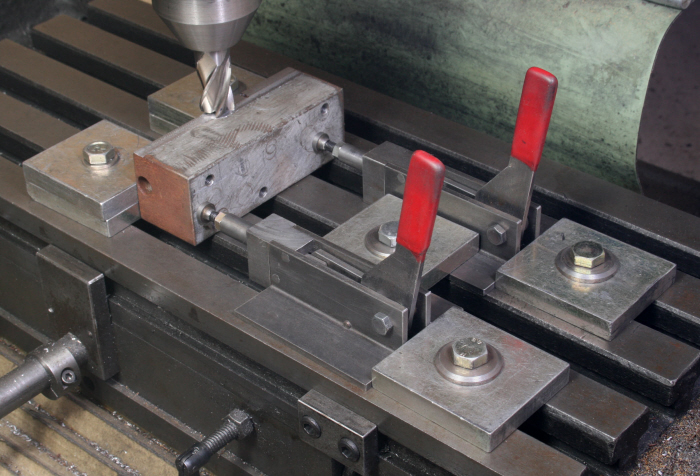
They are always used on one face with a fixed jaw supporting the opposite face of the component, as seen in Photograph 12 but being capable of a considerably force the fixed jaw must be firmly fixed as should the jaw move, if only very slightly, subsequent parts will be held much less securely. Because of this the fixed jaw should be fixed with screws passing through it rather than an overhead clamp and the clamp itself should similarly be securely clamped, maybe with additional rear supports as seen in the Photograph. I would though be hesitant to use them for any other than very light machining.
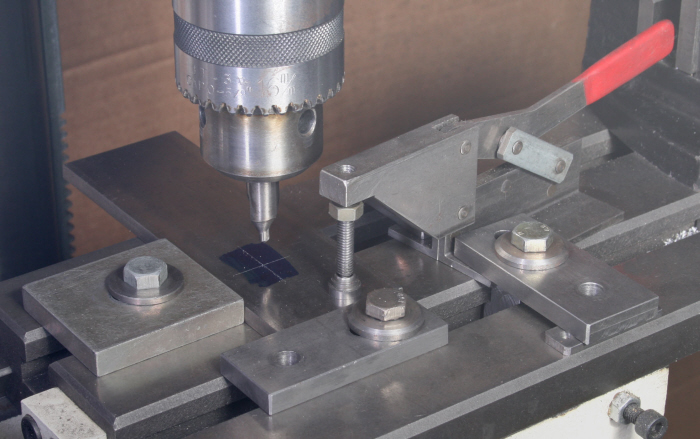
Vertical toggle clamps are also made but I would not use these for milling operations unless they were very heavy duty clamps and then only if side support was added by some means. They can though be very useful for drilling applications. In this case, if used with a fence or fences to locate the part, multiple parts could be made without having to mark each one out individually, Photograph 13.
Toolmaker's Clamps
These are frequently used to hold a workpiece to an angle plate or some other table mounted item, using them either exclusively, or together with other clamping devices. However, using toolmaker's clamps needs to be done with considerable caution as this is one situation where the clamping force is not just applied at the clamp's tip but equally along the whole length of the jaw. For details see my pages relating to them
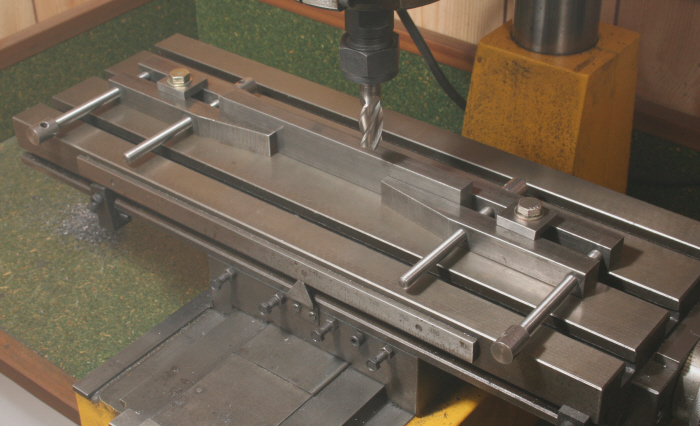
Another method of using the toolmakers clamps is to use them as low level vices as is shown in Photograph 14. In this case the bar had to be reduced from 1 inch to 25 mm, requiring it to be surfaced along its complete length. With the two clamps fitted and adjusted properly, they were held to the table with the two clamps making the task a simple one.

12

13
14