


Harold Hall
Cabinet Making
Oak. Has a straight grain with a light tan colour but a rather coarse texture and is a little more difficult to work with than the average. It can though have a smooth finish and accepts finishes well.
Elm (English) Unless "quarter cut", this has a pronounced grain pattern (see SK. 4 Th & Th) and, despite the efforts of Dutch Elm Disease, can still be located in small quantities. The heartwood is light to medium brown with the outer wood sometimes almost white and not usable if visible in the finish item,
Beech. Is a light coloured wood, white with a possible pink tint. The grain is straight and even. It is a very good timber for turning but also useful for furniture. Boards are often supplied with a waney edge so there is appreciable wastage.
Mahogany. Is a very well known timber having been used for furniture over many years. Prior to finishing it has a light to medium red colour. It works well and takes an excellent finish. However, the best mahogany comes from a source that could become endangered and so a lesser product (still quite good) is often all that is available.
Teak. This is a strong and durable wood with a straightish grain and having a bright brown colour. It has an oily surface that can make it difficult to glue. Finishing is frequently done using an oil. It is though an expensive wood and Iroko is often offered as an alternative. This works reasonably well but its sawdust can cause respiratory problems.
Lignum Vitea I have included this because of its unusual characteristics that surprisingly makes it useful in engineering applications. I had not heard about it until a friend told me how a local small firm had recently kept a compressor going by making a bearing out of it when a roller bearing failed and was proving difficult to obtain a replacement. A week or two later I met up with someone at the Model Engineer Exhibition who had recently returned from Australia and who, without prompting, told me virtually the same story relating to a firm in a very remote part of that continent where obtaining spares was frequently a problem. It is one of the heaviest species being around 80 lb per cubic foot, about twice that of those already mentioned.
Its very special characteristic is that its high resin content makes it self lubricating when used as a bearing. Because of this it is used even today as bearings for ship's propeller shafts as there is no suitable alternative apparently. It is expensive and difficult to work. If however you could acquire a small sample it would be interesting to experiment with.
Wood for carving
Lime, (similar timber called Basswood or American Linden) This is at the opposite end of the scale to Lignum Vitea being quite soft and half the weight (20 lbs per cubic foot) of the others mentioned. It is a light coloured straight grained wood that works very easily making it able to be worked to exhibit fine detail. Because of this it is probably the main wood used for carving.
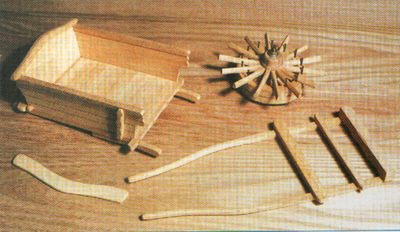
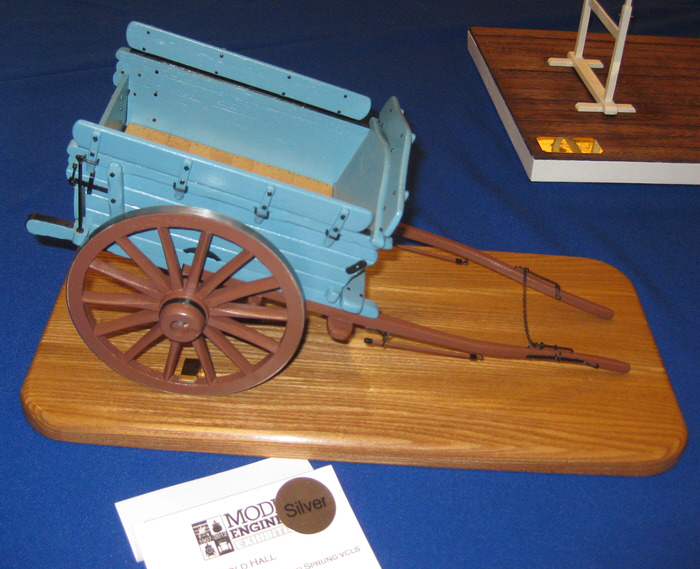
The part finished "Tip Cart" in Photo 4 being an example of a model cart which was made using Lime. Photo 5 shows the finish cart for which, if I may say, I was awarded a silver medal at the 2012 Model Engineering exhibition in the UK.



4
5
There is no larger view of Photo 4.