


Harold Hall
Cabinet Making


Getting to work.
Assuming you have kiln dried timber you can immediately start work bringing your timber to size, length, width and thickness, but leaving them a little oversize at this stage. Place your partially prepared timber in its final location, or somewhere with a similar climatic condition, for as long as the project will allow, at least two weeks as an absolute minimum. More, especially if the board thickness is in excess of 20mm. Lay them flat (not leaning against a wall) and separate them with small pieces of scrap to permit free air flow. Known as keeping them “in stick”
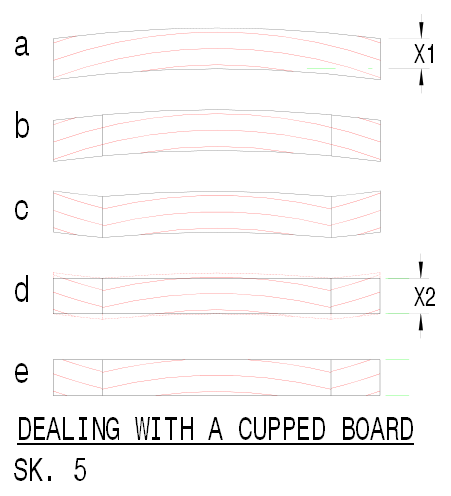
You may find after this, especially with wide boards, that some of your pieces have cupped across the width as in SK. 5a. You will need to cut the piece into strips "b" and reassemble (using adhesive) as in "c". It can then be finished to the required thickness as in "d". X1 and X2 show that there is less reduction in thickness, and therefore less work involved, to arrive at a flat board. Because of this the partially prepared boards must be acceptably oversize, say 2mm on thickness and 10 mm on width.
This may seem like a bodge, it is though standard practice in the cabinet making trade. In any case boards beyond say 150 mm finished, less for some species, may not be that easy to acquire so the practice of jointing boards is common. To minimise problems of cupping in the finished product, boards should be assembled with alternate boards reversed, that is with the growth rings producing hills and valleys. This can just be seen on the lower edge of Photo 3.
The Species
There are a very large number of species most of which are rare and unlikely to surface, even in a commercial woodworking workshop, probably wood turners regularly using the widest range. This still leaves a large number that are fairly common far too many to discuss in this article.
Another complication is that the names of what would appear well know timbers, Oak, Elm and Ash, typically, are far too general with different varieties of each being available, mostly when grown in different locations, typically, English Oak and American Oak being an example.
Describing these could be a major exercise, so will deal with just a few that are relatively common and a few of particular interest. Some suppliers have catalogues with quite detailed information on the subject of timber, including colour representations. These are worth acquiring. There are also some useful web sites giving descriptions of a wide range of timbers.
Obviously, with a few exceptions, "Hardwood" will work and finish quite differently to "Softwood", other than strength, the "Hardwoods" can be brought to an excellent surface finish, further enhanced by the application of a surface coating, wax, oil, varnish, etc.