


Harold Hall
Cabinet Making
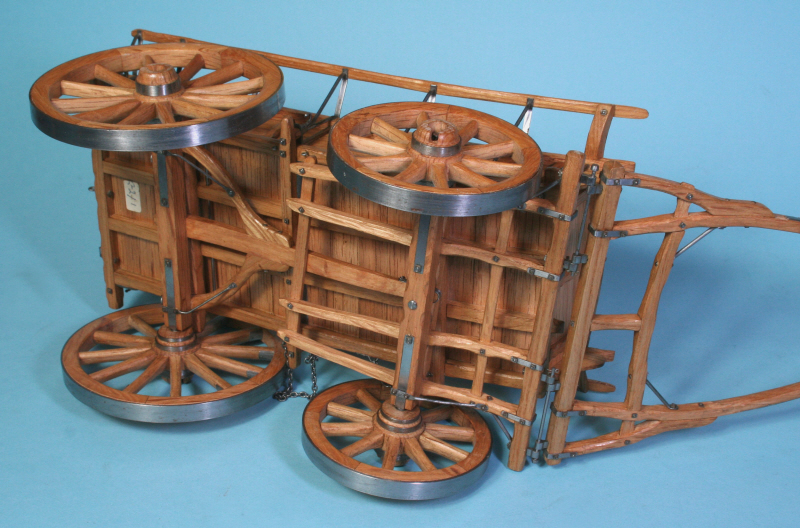
Most species, other than those that are very hard or have a very coarse grain, can be carved with greater or lesser ease. Photo 6 shows the underside of a Monmouth cart which is made from oak. For this I gained a bronze medal at the 1991 Model Engineering exhibition
Obtaining your timber
If your requirement is for a common timber it is worth looking in Yellow pages, under the heading "Timber Merchants". Whilst most will be for suppliers of "softwoods", some will advertise "hardwood". For a greater choice you will probably have to go further afield.
A good approach would be to acquire a copy or two of some woodworking magazines, TheWoodworker, Woodturning and Good Woodworking , typically, and search the advertisements. I include "Woodturning" as wood turners do seem to use a larger range of timbers. Their suppliers are also used to supplying timber in small quantities, typically turning blanks, but do also supply some species in board form.
Recapping on some important points. Boards will be, if sawn, in random widths and may contain some lighter coloured outer wood. They may be cupped or bowed. Even heartwood may vary in colour. Some faults may exist, knots, splits, etc. These factors all add up to a requirement to purchase sufficient excess timber to allow for waste. Planed boards may also have the above problems but if collecting you will be able to see what is being purchased, you will still need to purchase in excess of the theoretical minimum. Incidentally, "Hardwood" when sawn, is almost always sold by volume, the supplier making an allowance for any obvious faults.
Finishing
Having completed the constructional side of the project it will be unlikely that you will want to cover up the timber's decorative characteristic, hence the unpainted Monmouth cart which was finished with a basic wax furniture polish. Before applying the chosen polish the surface must be brought to a fine finish using progressively finer abrasive paper, finishing at 400 grit or finer.



6
Applying your chosen polish will inevitably change the colour of the timber, in some cases very little, in others quite marked. This will depend on the finish used and whether it includes an added stain. Testing this first on a piece of scrap should be considered a must. You may as a result decide to adjust the colour by using a wood stain. This is a wide ranging subject with virtually no second chance should you get it wrong. Do therefore talk to a specialist supplier and DO test the stain chosen on a few scrap pieces, also applying a coat or two of your chosen polish. Incidentally, a book I had on the subject of Wood Finishing had 26 pages on the use of stains and only 8 on polishes.
There are in everyday use just a few types of finishes, but for each type a wide variety of differing forms and from different manufactures. The short list will comprise of, Oil, Wax, French polish, Lacquer. I can therefore only advise you to obtain a catalogue or two from a supplier with a good range to choose from. Searching the internet or the magazines mentioned earlier would be a good starting point.
Oil. These, typically Linseed, Tung or Walnut, are very quick and easy to apply, though the protection given against heat and damp is not that great. This will improve with the number of coats applied, six should be considered a minimum. Apply the first coat using either a brush or a cloth and allow to soak in. After say 20 minutes wipe off any excess with a cloth and leave for 24 hours. Very lightly sand the surface using 400 grit paper and remove any sanding particles using a "tack" cloth. Repeat the full process again as many times as is necessary to get the required result.