
Harold Hall
Viewers may wonder what methods I used to acquire these values, incidentally all three values are read rather than calculated. Not so many years ago meters to read these parameters would have cost a considerable amount. However, the Brennenstuhl PM230 at under £20 (2006) and seen in Photo 1, is capable of being switched between time, volts, frequency, amps, Cosϴ, watts, kilowatt hours, and cost of power consumed. It also has some memory features that enable maximum values over a period of time to be read including running time.
Amongst other things I have found it interesting to use this instrument to find out how costly it is to provide continuous back ground heating to both my workshop and my greenhouse.


Knowing the values of R and X, and that they are at 90° one with the other, the angle ϴ can be calculated using simple trigonometrical principles. However, I must stress that I believe that this level of mathematical involvement with the subject, including the formula above, will be unnecessary for the vast majority of home workshop owners. My including them is an endeavour to emphasis the situation regarding power in an AC circuit.
Where then might this information be of practical importance? I have known workshop owners to place an ammeter in the supply to a machines AC drive motor so as to establish the mechanical power being demanded, using V x I to arrive at the power being consumed. The results from this though would be largely meaningless without knowing the power factor, enabling the electrical power consumed to be calculated. Even with this information, electric motors are notoriously inefficient if not run near to their rated load and so using this route to determine mechanical power needed is far from precise.
With this point in mind I have taken some readings for the drive motor on my lathe, a Myford super seven. These are for the lathe working in three conditions.
1. Line shaft only running.
2. Clutch closed and lathe spindle running 3. Machining a piece of steel 42 mm diameter. The speed was 600 rpm, feed rate 0.06mm and depth of cut 1.5 mm. The supply voltage was 240 V at 50 Hertz.
Amps Cosϴ Power Watts
Line shaft only 4.28 0.35 360
Mandrel running 4.35 0.41 430
Machining 4.60 0.60 662
From these figures it can be seen that taking the current readings as an indication of the electrical power consumed gives a totally false indication as the current increases by only 7% whilst the power consumed increases by 84%. Note how the value for Cosϴ varies for the three conditions. If the current value gives such an inaccurate indication of electrical power then using it to estimate mechanical load will be even further adrift.
Metalworking
Workshop Data
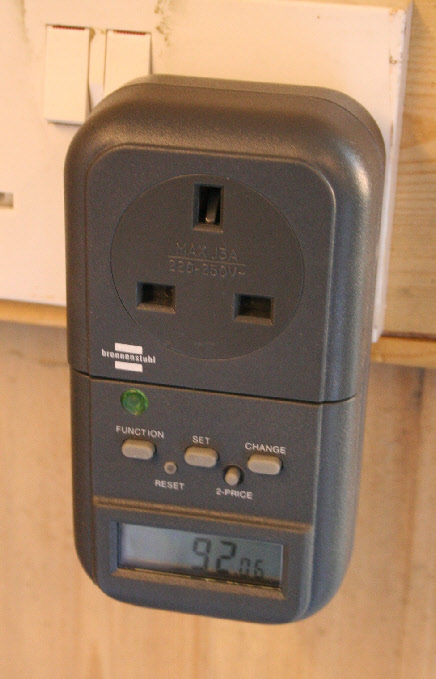
This type of meter is now widely available from other manufacturers.