

Harold Hall


Metalworking
Workshop Data
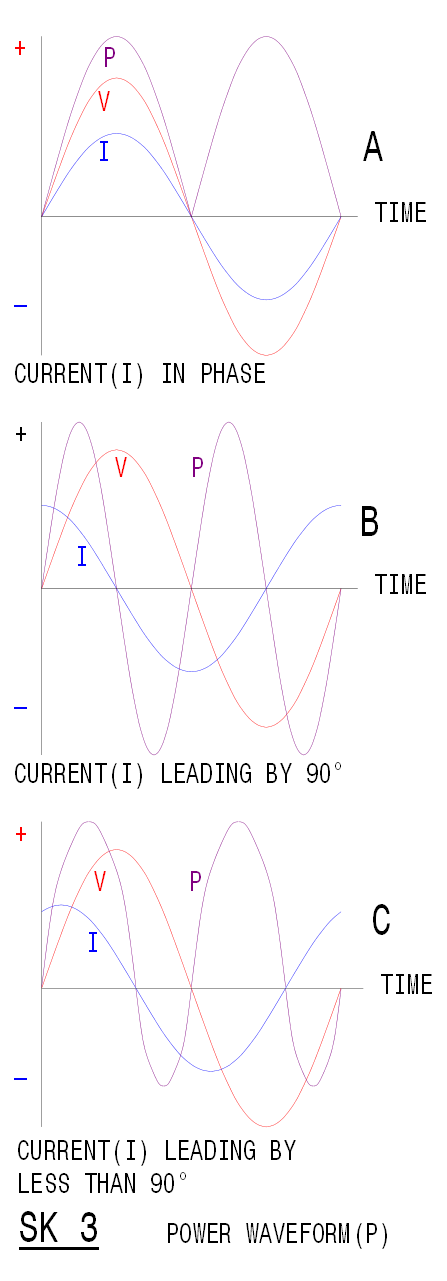
Sk 3 shows how the value of the instantaneous power (V X I) varies throughout the voltage cycle, with sketch A showing that when the voltage and current are in phase so is the power. However, you may be surprised to see the power waveform for the second half of the cycle is also positive. If you remember your maths you will know that a negative times a negative results in a positive, therefore negative voltage times negative current gives positive power.
In the case of sketch B, for a pure capacitive load, the current is leading by 90° and you have both positive and negative going power pulses, both being equal. The capacitor will be charged whilst the supply voltage is greater than the charge voltage but will discharge when the charge voltage is greater than the supply voltage. The result is that power is just shunted back and forth and over the cycle no power is consumed. From this it can be seen that with pure capacitance, and similarly pure inductance, connected to a supply, current will flow but over a complete cycle no power will be being consumed. This I expect will come as a surprise to some viewers.
Another interesting factor evident from sketch B is that the frequency of the power waveform is twice that of the supply frequency. The reason is because the instantaneous value of the power waveform will be zero every time that either voltage or current passes through zero which they do at different times. This situation will occur whenever V and I are out of phase though the two halves of the power cycle will not be equal if the angle of lead or lag is other than 90°, see sketch C. Here, less is being returned to the power source but the power consumed will still be less than the volts times current product.
I am concerned that this explanation has become more involved than I would like but have been unable to see a way of emphasising the crucial factor, that is, in an AC circuit, knowing the voltage and current will not enable you to determine the power being consumed. The essential additional factor is the angle of lag or lead. Knowing that, then calculating the power consumed is with the relatively simple formula
Power = V x I x Cosϴ watts
where ϴ equals the angle of lag or lead.
Cosϴ is known as the "power factor"