
Harold Hall
Having finished the smaller end apply a very thin film of marking blue to it adjacent
to the unfinished portion. Then, with the lathe running, very slowly advance the
finishing tool towards the blue area until there are just signs of the tool touching
the taper, then feed the top slide to finish the larger end. This should give a virtually
step-
Being your first taper turned using this method it is understandable if you still feel apprehensive regarding the result and wish to test the finished taper against the bore in which it is to fit. Very lightly mark the taper with marking blue and place it into its mating taper, having first cleaned it thoroughly. With the taper inserted just sufficiently to make full contact but still able to be rotated, rotate the taper one turn and remove.
If the taper is correct there will be some evidence of the blue having touched the internal taper at numerous points along its complete length. I think, like me, that after having made a few tapers using the method you will forgo the testing phase as done with care you will find the system foolproof.
As I have quoted an easily read difference of 0.040”, it would make no sense to convert this to a metric value for those with metric machines as the result, 1.016mm, would be difficult to read. For the benefit therefore of readers with metric machines the table gives distance between the edges for a 1mm difference in diameter.
Finally, if the taper is to be turned with the smaller end adjacent to the chuck, as is necessary in some cases, then the distance is between the two leading edges. It is preferable to make a second test piece for tapers made in this direction. Also, as the taper varies between Morse taper sizes, test pieces will be needed for every size being machined.
The method is of course not just applicable to Morse tapers but can be used for any required taper, to do this, given the angle of the taper, workout the distance between the measuring edges for a difference of 0.040”, or 1mm, and make a test piece to these dimensions.
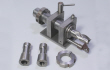
If you have measuring equipment that can cope with longer test pieces, then double the values in the table and work with a difference of 0.080”. This will assist in achieving an even more accurate result. Photograph 3 shows four test pieces, some of which are double length.



Workshop Processes

3