
Harold Hall
Workshop Processes

Machining Cast Iron
Machining a Vee angle plate, Harold Hall
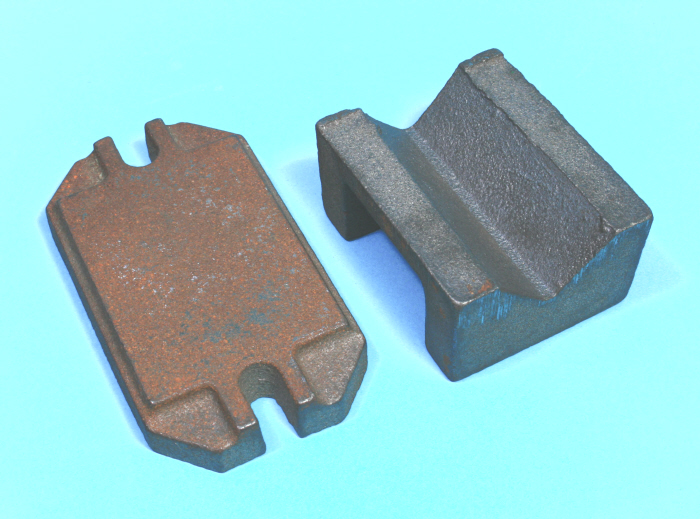
Elsewhere on the website I have discussed the considerations necessary when choosing the sequence for machining a casting, and illustrated this by showing the methods I adopted when making a Keats Angle Plate. With the same principle in mind. this time I am making the Small Vee Angle Plate which, like the Keats, is also available from “The College Engineering Supply”. Whilst performing much the same tasks as the Keats it is constructed quite differently so provides a range of other possibilities where machining is concerned. The castings for this are shown in Photograph 1.
The Vee Block
The casting is basically a six sided block with the two larger faces parallel and the four shorter faces tapered and with the essential requirement for the finished block being that the six sides must all be at 90° with their adjacent faces. This, a major consideration when choosing the machining methods.
As was the case with the Keats, the first face to machine is one of the tapered faces and whilst any one would suffice I chose one of the longer ones. Having carried out the preliminary tasks of chamfering the edges and checking that the main face was adequately flat for it to be mounted on the angle plate I machined the first face as shown in Photograph 2. Then, with the casting still clamped to the angle plate the angle plate was stood on its end, clamped to the machine table, and the first smaller face also machined, Photograph 3. This ensured that the two faces were at 90° to each other without the complications presented by other methods. Whilst not often a method to adopt do not loose sight of the fact that using an angle plate in this way can occasionally be beneficial, providing that is, that your angle plate is accurately made.
The next stage was to machine the opposite faces in a manor that would ensure they were parallel and was done by mounting the casting directly on the machine table, Photographs 4 and 5. The method in photograph 4 may look dubious but there is a second clamp being used in the same way as that seen but hidden behind the casting. The set up in photograph 5, and that also in the next photograph use my high profile clamps. See here.


1
2
3

4
5
All pictures can be clicked on to provide a larger view