


Harold Hall
Cabinet Making
Stability
Before we discuss conversion methods further, stability needs to be considered. It will come as no surprise that timber is a commodity that changes shape and size quite appreciably, due mainly to the changes in moisture content. Most changes will have occurred in the drying processes carried out by the timber processor but will still continue, though by smaller amounts, once it arrives in the workshop. Changes will also continue into its final location, especially if destined for our modern centrally heated homes. Release of in built tensions when cutting, or planing, to a smaller size can also be a problem.
Movement can occur:-
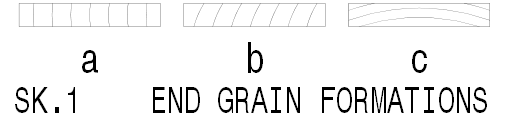
SK. 1 shows three typical end grain formations. The board shown in "A" will change just a little in width due to the very small changes between growth rings and whilst there will be a potentially greater change along the growth rings the amount will be very small due to it being relatively thin. Board "C" on the other hand will change appreciably in width and very little in thickness. Therefore, for stability, and other reasons as will be explained, boards as in "A" are preferred, but are much more expensive due to more work being involved in the conversion.
Also in the case of board "C" the board will be prone to "cup" due to the difference in growth line lengths and can also "twist" and "bow" along the length.
After cutting, boards will be air and often kiln dried also. Do though ensure you purchase kiln dried timber. Air drying is a slow process with 1 year per 1" thickness being a quoted time and even then having a much higher moisture content than kiln dried timber.
Conversion methods (continued)
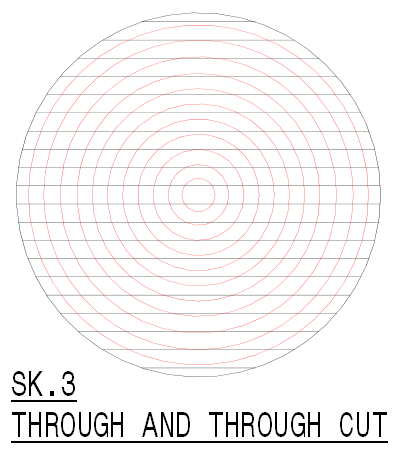
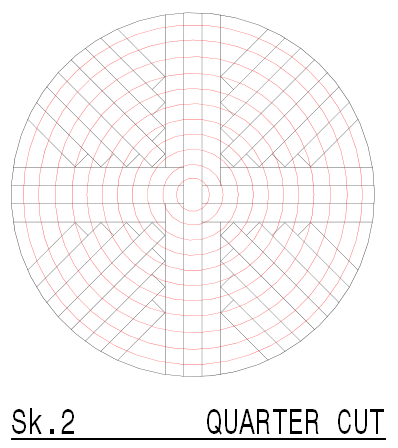
There are two methods (with variations) of cutting the felled log "quarter sawn" (SK. 2) and "through and through" (SK. 3). Whilst there are advantages of stability with "quarter sawn" boards that conform to SK. 1a, it can be seen that there is an appreciable amount of scrap. This, together with what is a more complex operation, makes the boards more expensive, as a result, "quarter sawn" boards are not so readily available.
The method shown in SK. 3 is known as "through and through" being a relatively simple operation with wastage minimal. It will produce boards of types "a" "b" and "c" though only the centre board or two will truly conform to a "quarter sawn" board. The converter, may chose to leave this in with the rest in which case you may find a board or two like this available.