
Harold Hall
Metalworking
Workshop Set Ups
Taper Stub Mandrel Setups. Harold Hall
Taper stub mandrels have a parallel portion being a very close fit in the workpiece to be fitted, from there, the mandrel enlarges having a shallow taper. The workpiece is pressed on with a slight twisting action which provides sufficient grip for light machining to take place.
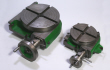
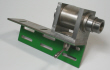
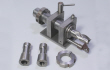
The benefits of the method are that the outer diameter can be fully machined and will be precisely concentric with the bore if the mandrel has remained in the chuck after machining. Also, both sides of the workpiece can be machined, Care must be taken though on the chuck side as the machining will be attempting to force the workpiece off the taper. Photos 1, 2 & 3 are typical examples.
Ideally, the width of the part should be at least half the diameter of the bore, preferably more, Photo 4. If not, then it will be difficult to fit as it will be inclined to fit at an angle. However, this can be overcome by pressing it onto the mandrel using the end of the lathe’s tailstock. If the mandrel is too large for the bore of the tailstock then equal thickness packing either side of the mandrel will need to be used. LINK
Photo 5 shows a rather special application. In this the mandrel has two taper sections, one to hold the gear and one to hold the dial being engraved. If the mandrel has been made and used without removing it from the lathe the outer diameter can be machined true ensuring that the depth of the engraving will be consistent. Then, after engraving, the outer diameter can be given a very shallow finishing cut to remove the burs produced.


1

2

4


5
All pictures can be clicked on to provide a larger view

3